How to price items on eBay: use sold listings, not asking prices
Price from what buyers actually paid, not what sellers are asking. How to read sold listings and Product Research, compare like with like, and pick a format.
Ashish · 5 min read
There's a jacket on eBay listed at $240. Another at $210. A third at $260. So you list yours at $230 and feel pretty good about it.
It doesn't sell. Neither do the other three. They've all been there for four months.
The asking prices told you what sellers hope for. They told you nothing about what buyers pay. On eBay, you can see the second number, and it's the only one worth pricing from.
Step 1: search sold items, not active ones
Search eBay for your item, then open the filters and tick Sold items. Prices in green are what buyers actually paid. eBay's own help page suggests using search to find similar listings when you're unsure of an item's value (eBay Help: pricing your items).
Now you're looking at real demand, not hope.
Step 2: compare like with like
A sold price only helps if the item matches yours. Narrow it down:
- Same item: brand, model, size, colour.
- Same condition: new with tags, used, for parts. The difference is often large.
- Same extras: original box, charger, accessories, receipts.
- Same postage: compare the total, price plus postage, because that's what the buyer compared too.
Ignore the one sale that went for double. Ignore the one that went for a dollar at 3am. Look at the middle of the range.
Step 3: use Product Research for the bigger picture
In Seller Hub, open the Research tab. eBay's Product Research tool is free for sellers and gives up to three years of sales data: average sold price, sold price range, average shipping, the share sold with free shipping and the sell-through rate.
Sell-through rate is the one most sellers skip. It's roughly how many listings sold compared with how many were listed. A high rate means buyers snap these up. A low one means a lot of supply sitting unsold, so price toward the lower end of the range or make your listing clearly better.
Step 4: decide where your price sits
With the sold range in front of you, pick your position:
| Position | When it makes sense |
|---|---|
| Low end | You want a quick sale, or the condition is worse than most |
| Middle | Standard condition, standard extras |
| High end | Better condition, the original box, rare colour, extras, great photos |
If you price at the high end, the listing has to show why. Say "with original box and both chargers" in the title and the description, and photograph them.
Step 5: choose the format
eBay's guidance: use an auction when you're not sure of the value, or the item is unique or hard to find. Use fixed price when you know the value, have several of the same item, or want the listing to show for longer than 10 days.
For fixed price, consider allowing offers. It tells you what buyers are willing to pay without you dropping the price for everyone.
Step 6: check postage
A low price with high postage loses to a slightly higher price with free or cheap postage. Price both together. eBay's Best Match factors include price and your selling terms, so the total matters to how your listing ranks, too.
A worked example
A made-up item to show the process.
A seller has a used pair of over-ear headphones in good condition, with the case but no box.
- 1Active listings: $120 to $180. Not useful yet.
- 2Sold items, same model: $70 to $140 over recent weeks.
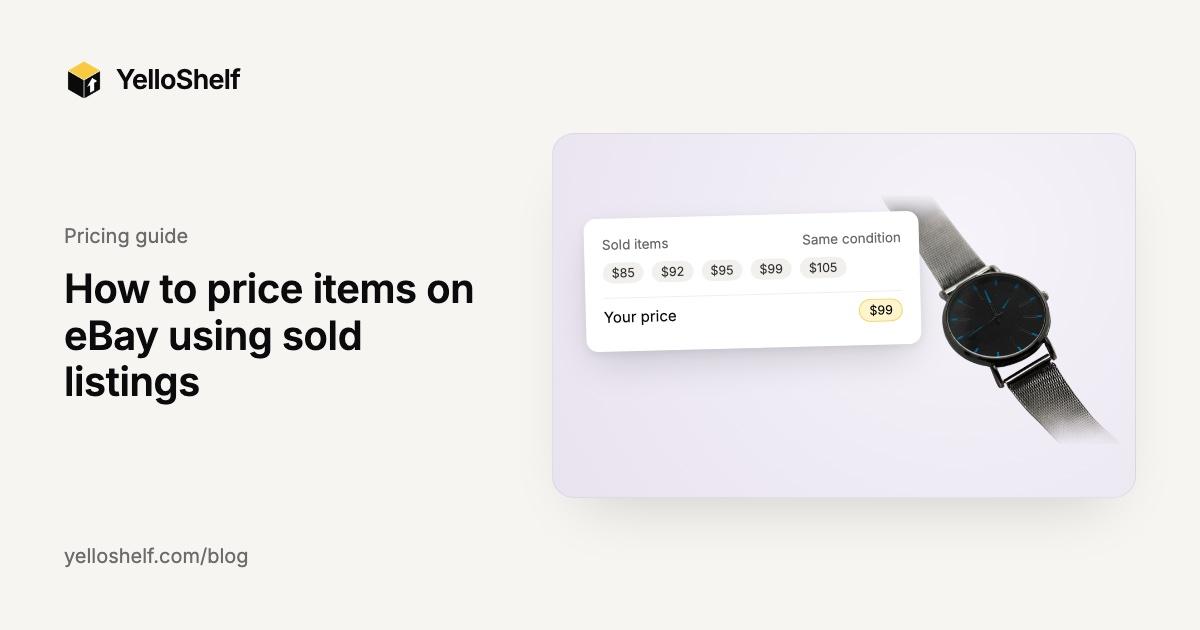
- 3Same condition, with case, no box: $85 to $105, most around $95.
- 4Product Research: a healthy sell-through rate, so these move.
- 5Decision: fixed price at $99 with free postage, offers allowed.
If it still doesn't sell
Price is only one reason. If a fairly priced listing sits, check the title, item specifics and photos. Our guides to why your eBay items aren't getting views and eBay item specifics go through those.
A second opinion on price, with the listing
Sold listings are the best guide, and nothing replaces looking at them yourself. But if you're listing a lot of items, the research adds up.
When you pick eBay in Product listings, you add photos of your item and answer the questions a photo can't. Along with the 80-character title, the item specifics and the description, we suggest a price from similar listings in your country, inside the market's usual range. If you've added your shop, we also look at what you usually charge. You always decide the final price.
Quick checklist
- Sold items checked, not just active listings.
- Compared like with like: model, condition, extras, postage.
- The middle of the range used, not the outliers.
- Product Research checked for sell-through rate.
- Price position chosen, and the listing shows why.
- Format chosen: auction or fixed price.
- Price and postage judged together.
Your first Product listing or Listing review is free. After that, credit packs start at $10, with no subscription.
Made by the team behind YelloShelf
Get a suggested price with every eBay listing
From similar listings in your country, with the title, item specifics and description written from what buyers search. You always set the final price.
- Your first listing or review is free
- Pay as you go credit packs from $10
- No subscription
- 7-day money-back guarantee on your first purchase
FAQ
How do I find out what my item is worth on eBay?
Search for it, then tick Sold items in the filters. Those are the prices buyers actually paid. Compare items in the same condition, with the same accessories, and look at the range rather than a single sale. Seller Hub's Product Research tool shows longer sales history.
What is eBay Product Research?
A free tool in the Research tab of Seller Hub. eBay says it gives access to up to three years of sales data, including average sold price, sold price range, average shipping and sell-through rate.
Should I sell on eBay as an auction or fixed price?
eBay suggests an auction when you're unsure of the value or the item is rare, and fixed price when you know the value, have several of the same item, or want the listing to stay up longer. Most everyday items sell at fixed price.
Why isn't my eBay item selling at my price?
Usually because the total cost, price plus postage, is above what similar items sold for, or the listing doesn't show why yours is worth more. Compare with sold items in the same condition, and make the condition, extras and photos clear.