How to write product descriptions in your brand voice (not generic AI)
Every shop that uses the same AI tool sounds the same. How to find your own voice in what you've already written, turn it into a few rules, and keep every listing sounding like you.
Ashish · 5 min read
Read these two descriptions for the same candle. Both are made up for this guide.
Transform your space with this luxurious hand-poured candle, the perfect addition to any home. A must-have gift for any occasion!
Fig, black tea and a bit of cedar. We pour these in small batches in our kitchen in Leeds, and this one smells like the first cold morning in October.
The first could be from any shop on the internet. It probably is, word for word, in plenty of them. The second could only be from one.
That's brand voice. Not a logo, not a colour palette. The way your words sound, so that a buyer who reads three of your listings feels like they know who's behind them.
Why it matters more now
AI tools made writing listings fast. They also made most listings sound identical, because when a tool knows nothing about your shop, it falls back on the safest marketing words it knows. "Transform your space". "Must-have". "Perfect for any occasion".
Buyers notice. On Etsy especially, people often choose a shop because it feels like a real person made the thing. A voice that sounds like everyone else throws that away.
Step 1: find your voice in what you've already written
You already have a voice. It's in the things you wrote when you weren't trying to "write copy":
- Your best-selling listing. What does its description sound like?
- Your About section.
- Messages to customers you were pleased with.
- Your social captions, if you post.
Read them together and note:
- Words you use often. "Small batch", "hand-stamped", "lovely", "sturdy".
- How you talk to the buyer. "You" or "they"? Warm or matter-of-fact? Jokes or none?
- Sentence length. Short and punchy, or longer and descriptive?
- What you always mention. Where it's made, how it's made, how long it lasts.
Step 2: write it down as five rules
A voice you can't describe is a voice you can't keep. Turn your notes into a short list you can check against. For example:
- 1We say "we", and talk to the buyer as "you".
- 2Short sentences. No exclamation marks.
- 3We always say what it's made of and where.
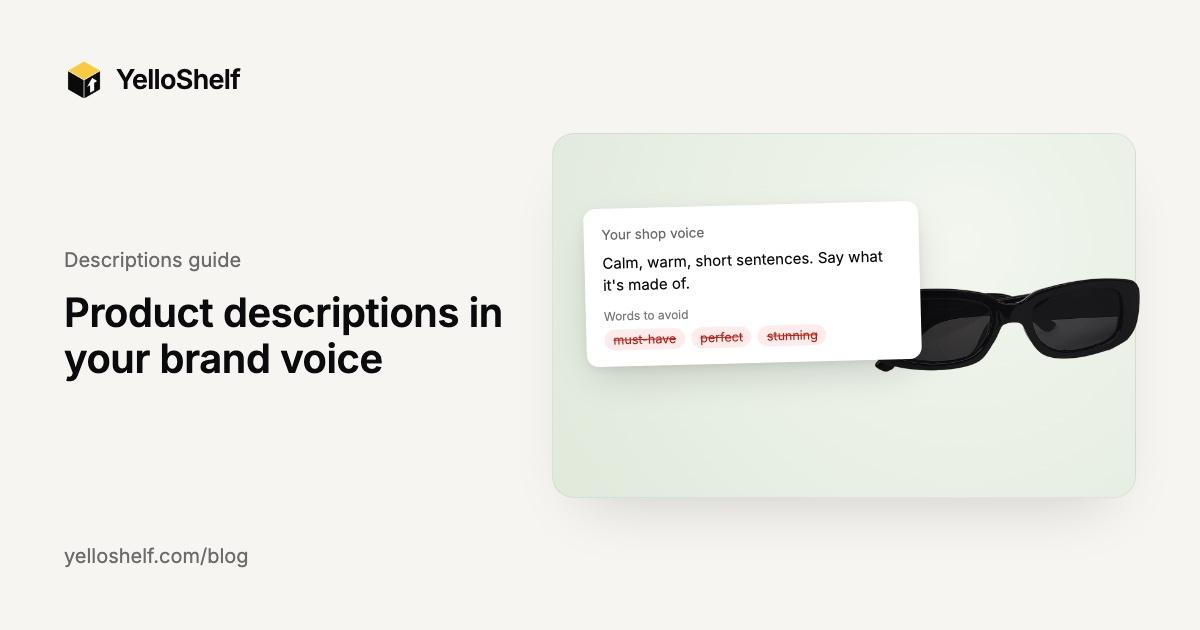
- 4We describe smell, feel and use, never "luxurious" or "premium".
- 5Words we never use: must-have, perfect, stunning, luxurious.
Keep the list next to you when you write, and give it to anyone who writes for your shop.
Step 3: keep the facts, change the sound
Voice doesn't replace facts. Every description still needs the size, the materials, what's included and how to care for it. Voice is how you say them.
- Flat: "Dimensions: 10 x 8 cm. Material: soy wax."
- Generic: "This stunning candle is the perfect size for any room!"
- In voice: "It's 10 cm tall, small enough for a bedside table, and poured from soy wax that burns clean."
Same facts. Only one sounds like a person.
Step 4: write the opening line last
The first line of a description is what search results and previews show. Write it after the rest, once you know what the most important thing is, and make it sound like you while still saying what the item is in the words buyers search.
Our Etsy listing description template and our guide on how to write a product description for your website give you a structure to put your voice into.
Step 5: check for drift
Every few months, read five of your listings in a row. Do they sound like the same shop? Older listings often sound different, because you've changed since you wrote them. Bring the best sellers in line first.
Using AI without losing your voice
If you use an AI tool to draft listings, it'll sound generic unless you give it something to work with:
- Paste in two or three of your own descriptions as examples.
- Give it your five rules, including the words you never use.
- Give it the facts, and tell it not to add any. See our ChatGPT prompt for an Etsy listing for prompts that do this.
- Read every draft out loud. If you wouldn't say it to a customer, change it.
How YelloShelf learns your voice
Sounding like your shop is built into Product listings.
Add your shop link once: your website, Shopify, Etsy, eBay or Amazon store. We read your public pages to learn your tone, your best sellers, your usual prices and the words you use. It takes under a minute, it's free, and you can edit what we learned or skip it. We never copy your existing product names.
After that, every listing we write sounds like your shop. You can also give us words to avoid. We still only use facts from your photos and answers, and we look up what buyers search, so the listing sounds like you and still gets found.
Quick checklist
- Your best listing, About section and customer messages reread.
- Words you use, how you address buyers and sentence length noted.
- Five voice rules written down, including words you never use.
- Facts kept, sound changed.
- Opening line written last.
- Listings reread together every few months.
Your first Product listing or Listing review is free. After that, credit packs start at $10, with no subscription.
Made by the team behind YelloShelf
Listings that sound like your shop
Add your shop link once. We read it to learn your tone and the words you use, then every listing we write sounds like you, not like generic AI.
- Your first listing or review is free
- Pay as you go credit packs from $10
- No subscription
- 7-day money-back guarantee on your first purchase
FAQ
What is brand voice in a product description?
The way your shop sounds: the words you choose, how long your sentences are, how formal you are, and what you always mention. A clear voice makes every listing feel like it came from the same people.
How do I find my brand voice?
Look at what you've already written that worked: your best listing, your About section, replies to customers you're proud of. Note the words you repeat, how you address the buyer and what you never say. That's your voice. Write it down as a few rules.
Why do AI product descriptions sound the same?
Because most tools fall back on the same safe marketing words when they don't know anything about your shop: transform your space, must-have, perfect for any occasion. Giving a tool examples of your own writing and a list of words to avoid makes a big difference.
Should every product description sound the same?
The voice should stay the same; the content shouldn't. Each listing still needs its own facts, but the tone, the structure and the words you use should feel like one shop.